


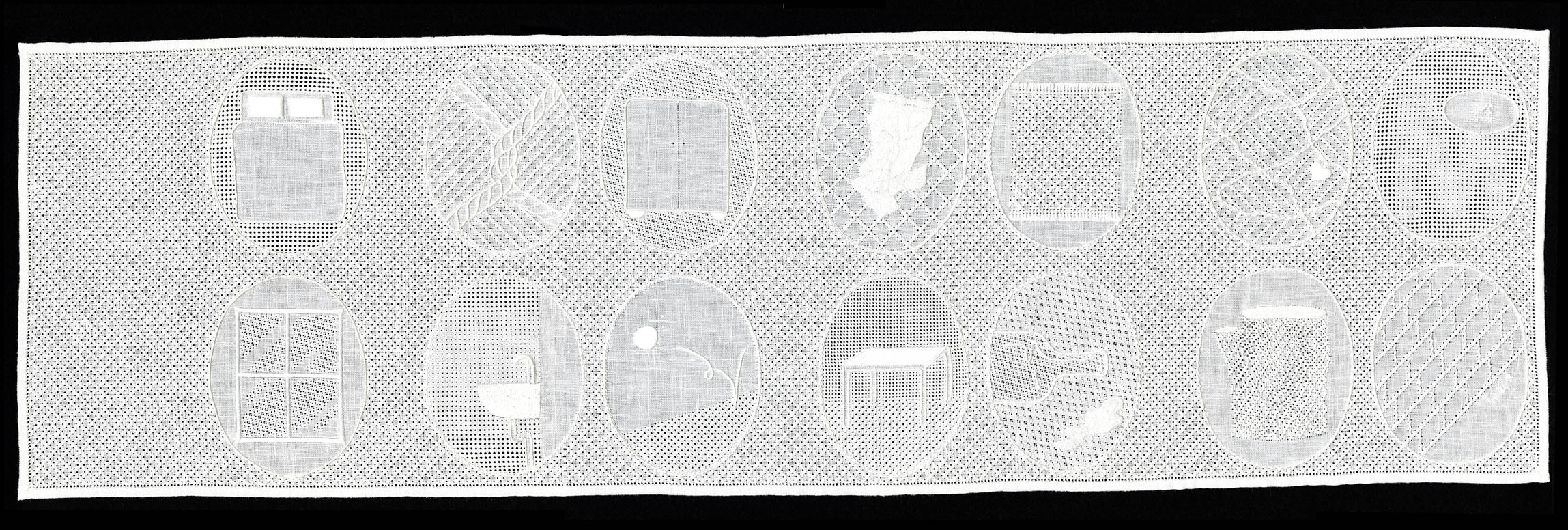
To celebrate MacGuffin’s tenth anniversary, artist Masaki Komoto spent days stitching his way through the archive of back issues, translating each theme into thread.
Words and stitches by Masaki Komoto
3. Bhojraj, Portrait of Prince Muhammad Buland Akhtar at Prayer, c. 1700 –1750. Courtesy The Metropolitan Museum of Art, New York
Nº 1 The Bed
Pulled thread: Four-sided stitch
Outline: Trailing stitch
The area around the bed is worked in four-sided stitch, while the bed itself is left blank to resemble sheets. The outline is in stem stitch. The pillows are highlighted with padded satin stitch, which also refers to the halftone image on the magazine cover.
Pulled thread: Four-sided stitch
Outline: Trailing stitch
The area around the bed is worked in four-sided stitch, while the bed itself is left blank to resemble sheets. The outline is in stem stitch. The pillows are highlighted with padded satin stitch, which also refers to the halftone image on the magazine cover.
Nº 2 The Window
Pulled thread: Diagonal drawn filling
Outline: Trailing stitch
The window frame is highlighted in satin stitch, and the glass is rendered with a diagonal drawn filling. Leaving diagonal bands unstitched echoes the way glass is shown in comics.
Pulled thread: Diagonal drawn filling
Outline: Trailing stitch
The window frame is highlighted in satin stitch, and the glass is rendered with a diagonal drawn filling. Leaving diagonal bands unstitched echoes the way glass is shown in comics.
Nº 3 The Rope
Pulled thread: Diagonal cross filling
Outline: Whipped back stitch, back stitch
The ropes are drawn in stem stitch. Their twisted form is conveyed with an X shape. They divide the oval into four sections, with diagonal cross filling worked in two directions. Layering these creates an open trellis, a deconstructed version of the background.
Pulled thread: Diagonal cross filling
Outline: Whipped back stitch, back stitch
The ropes are drawn in stem stitch. Their twisted form is conveyed with an X shape. They divide the oval into four sections, with diagonal cross filling worked in two directions. Layering these creates an open trellis, a deconstructed version of the background.
Nº 4 The Sink
Pulled thread: Four-sided stitch
Outline: Back stitch
I based the shape on the sink in my workspace. The wall is left as bare fabric, while the space is worked in four-sided stitch with neatly arranged dots, using varied tension for a gradient-like effect. The halftone pattern is a recurring feature on MacGuffin covers. I wanted to test whether halftone could be translated into pulled thread embroidery by hacking a system designed for uniformity.
Pulled thread: Four-sided stitch
Outline: Back stitch
I based the shape on the sink in my workspace. The wall is left as bare fabric, while the space is worked in four-sided stitch with neatly arranged dots, using varied tension for a gradient-like effect. The halftone pattern is a recurring feature on MacGuffin covers. I wanted to test whether halftone could be translated into pulled thread embroidery by hacking a system designed for uniformity.
Nº 5 The Cabinet
Pulled thread: Diagonal drawn filling
Outline: Back stitch, half feather stitch
This cabinet stands in the apartment of my dear friends Nina and Smari. We’ve known each other since moving to the Netherlands in 2011, and Smari’s artwork appeared in Nº 1 The Bed in 2015. Making work for a magazine my friends once contributed to is especially meaningful. The narrow gap between the panels is created by removing vertical drawn thread work. The hole for the handle is made by simply piercing the fabric — a technique also used for eyelets.
Pulled thread: Diagonal drawn filling
Outline: Back stitch, half feather stitch
This cabinet stands in the apartment of my dear friends Nina and Smari. We’ve known each other since moving to the Netherlands in 2011, and Smari’s artwork appeared in Nº 1 The Bed in 2015. Making work for a magazine my friends once contributed to is especially meaningful. The narrow gap between the panels is created by removing vertical drawn thread work. The hole for the handle is made by simply piercing the fabric — a technique also used for eyelets.
Nº 6 The Ball
Pulled thread: Diagonal cross filling
Outline: Half feather
So far, the objects were quite static, so I broke the rhythm by suggesting movement with a ball. The diagonal cross filling at the bottom creates a sense of space and divides the oval into two panels.
Pulled thread: Diagonal cross filling
Outline: Half feather
So far, the objects were quite static, so I broke the rhythm by suggesting movement with a ball. The diagonal cross filling at the bottom creates a sense of space and divides the oval into two panels.
Nº 7 The Trousers
Pulled thread: Open trellis filling
Outline: Button hole stitch
The same open trellis filling appears in the background, but at a different pitch, creating a larger crisscross pattern. I often leave my trousers on the floor — lazy, but the shapes are fun. They’re filled with long and short stitch for a gentle sheen. Changing stitch direction allows different parts to reflect the light differently.
Pulled thread: Open trellis filling
Outline: Button hole stitch
The same open trellis filling appears in the background, but at a different pitch, creating a larger crisscross pattern. I often leave my trousers on the floor — lazy, but the shapes are fun. They’re filled with long and short stitch for a gentle sheen. Changing stitch direction allows different parts to reflect the light differently.
Nº 8 The Desk
Pulled thread: Single faggot stitch, diagonal cross filling
Outline: Cable stitch
I drew an archetypical desk shape and highlighted the top panel with satin stitch. As with Nº 6 The Ball, I suggested space by placing two horizontal panels of pulled stitches with different hope arrangements and sizes.
Pulled thread: Single faggot stitch, diagonal cross filling
Outline: Cable stitch
I drew an archetypical desk shape and highlighted the top panel with satin stitch. As with Nº 6 The Ball, I suggested space by placing two horizontal panels of pulled stitches with different hope arrangements and sizes.
Nº 9 The Rug
Pulled thread: Open trellis filling
Outline: Cable stitch, scroll stitch
The rug is made with open trellis filling and fringe-like stitches along the top and bottom edges. The rest of the oval is left unstitched. I love the subtlety of the #9 The Rug cover — you have to look closely to see what it is. I was also exploring a minimalist approach, inspired by works from Japan’s Mono-ha school of the 1960s and 1970s.
Pulled thread: Open trellis filling
Outline: Cable stitch, scroll stitch
The rug is made with open trellis filling and fringe-like stitches along the top and bottom edges. The rest of the oval is left unstitched. I love the subtlety of the #9 The Rug cover — you have to look closely to see what it is. I was also exploring a minimalist approach, inspired by works from Japan’s Mono-ha school of the 1960s and 1970s.
Nº 10 The Bottle
Pulled thread: Diagonal drawn filling
Outline: Scroll stitch
By this point, the physical burden of stitching long hours over many days and weeks had set in. I began dreaming of partying and getting drunk, enough not to care about the bottles on the floor, so I stitched one. The bottle’s inside and outside are worked in diagonal drawn filling, but with different thread weights and stitch counts. I added a puddle-like situation in a long and short stitch to ‘highlight’ parts of the piece. While stitching, I noticed the vertical crosses resemble the Chinese character 十 (10), fitting for the 10th edition. A sweet coincidence!
Pulled thread: Diagonal drawn filling
Outline: Scroll stitch
By this point, the physical burden of stitching long hours over many days and weeks had set in. I began dreaming of partying and getting drunk, enough not to care about the bottles on the floor, so I stitched one. The bottle’s inside and outside are worked in diagonal drawn filling, but with different thread weights and stitch counts. I added a puddle-like situation in a long and short stitch to ‘highlight’ parts of the piece. While stitching, I noticed the vertical crosses resemble the Chinese character 十 (10), fitting for the 10th edition. A sweet coincidence!
Nº 11 The Chain
Pulled thread: Diagonal cross filling
Outline: Chain stitch
Some embroidery stitches include the word ‘chain’, fitting here. This composition echoes Nº 3 The Rope, but with a finer thread in the diagonal cross filling for a subtler effect. The heart motif comes from my favourite necklace, bought in Tokyo.
Pulled thread: Diagonal cross filling
Outline: Chain stitch
Some embroidery stitches include the word ‘chain’, fitting here. This composition echoes Nº 3 The Rope, but with a finer thread in the diagonal cross filling for a subtler effect. The heart motif comes from my favourite necklace, bought in Tokyo.
Nº 12 The Log
Pulled thread: Open trellis filing
Outline: Coral stitch
The log’s composition directly references the magazine cover. Again, it plays with the idea of hacking the system. To suggest a rugged texture, I introduced irregularity into the open trellis filling, by keeping the stitch technique and horizontal count consistent but randomizing the vertical count.
Pulled thread: Open trellis filing
Outline: Coral stitch
The log’s composition directly references the magazine cover. Again, it plays with the idea of hacking the system. To suggest a rugged texture, I introduced irregularity into the open trellis filling, by keeping the stitch technique and horizontal count consistent but randomizing the vertical count.
Nº 13 The Letter
Pulled thread: Four sided stitch
Outline: Coral stitch, stem stitch
The large M recreates the halftone image from this edition’s cover — a more elaborate take on the imagery from Nº 4 The Sink. I layered a cross-stitch M in a small oval over the halftone M. As M is the thirteenth letter of the alphabet, I added a small one at the top: a quiet signature for MacGuffin and for myself, Masaki.
Pulled thread: Four sided stitch
Outline: Coral stitch, stem stitch
The large M recreates the halftone image from this edition’s cover — a more elaborate take on the imagery from Nº 4 The Sink. I layered a cross-stitch M in a small oval over the halftone M. As M is the thirteenth letter of the alphabet, I added a small one at the top: a quiet signature for MacGuffin and for myself, Masaki.
Nº 14 The Wall
Pulled thread: Diagonal cross filling
Outline: Stem stitch
I wanted the wall to point to what comes next — because life, and the life of things, continues. The diagonal composition opens to the right. I kept one direction of diagonal cross filling and added vertical lines to create a brickwork effect. A few weeds and a small flower hint at the ground beyond the stitched area. The painter Hugo Rocci, who contributed to Nº 14 The Wall, was a classmate of mine at art school in Amsterdam. The flower reminded me of his warm, generous character.
Pulled thread: Diagonal cross filling
Outline: Stem stitch
I wanted the wall to point to what comes next — because life, and the life of things, continues. The diagonal composition opens to the right. I kept one direction of diagonal cross filling and added vertical lines to create a brickwork effect. A few weeds and a small flower hint at the ground beyond the stitched area. The painter Hugo Rocci, who contributed to Nº 14 The Wall, was a classmate of mine at art school in Amsterdam. The flower reminded me of his warm, generous character.


